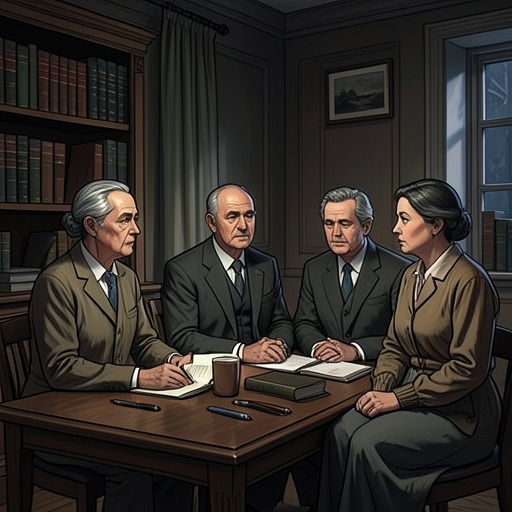
The six years since the poisoning
We Have Always Lived in the CastleThe six years since the poisoning form a span of constrained routine and accumulating change in the Blackwood household. The interval is measured not only by the family deaths but by what continues afterward: Constance’s care of the house, Mary Katherine Blackwood’s necessary trips into the village, and the persistent presence of household objects whose order is disturbed only as the outside world presses closer.
Time and Household Continuity
The family’s sense of time is bound to a home designed to resist movement. The Blackwoods rarely rearrange their possessions; objects are returned to their places, while generations of family property accumulate and seem to hold the house steady against the world. This settled order makes the six-year interval feel both long and strangely unchanged. Constance reflects that it hardly seems six years since the deaths, even as she admits that she would give anything to have the dead family members back.
The routine depends on a division of daily tasks shaped by the family’s circumstances. Constance does not go beyond her garden, and Julian Blackwood is unable to make the trip into the village, so Mary Katherine goes there on Fridays and Tuesdays for books and groceries. The Harrises stopped delivering dairy goods six years earlier; milk and butter now have to be carried home from the store. These errands make the passage of time concrete: the household persists, but its old arrangements have been altered by the poisoning and its aftermath.
Village Contact and Social Exclusion
The trips expose Mary Katherine to a village that watches her and treats her presence as a source of uneasy attention. In the grocery, customers wait for her to leave before resuming their talk. Mrs. Donell is among the few who speak to her, and the Blackwoods’ former standing is invoked in a remark about their fine table. Mary Katherine endures these encounters because the household needs food and books, but she also insists on entering Stella’s for coffee rather than avoid being seen. Her account makes the errand a repeated negotiation between practical necessity and the village’s hostility.
The family’s isolation is therefore neither complete nor simply chosen in every instance. Constance remains within the garden, Julian cannot go out, and Mary Katherine bears the burden of public contact. Constance advises her not to show that the villagers’ behavior matters, while Mary Katherine privately imagines their deaths. The contrast between outward restraint and inward anger gives the six-year period an unresolved social dimension: the family has survived the poisoning, but ordinary contact with the village remains charged by it.
The Poisoning as a Continuing Presence
The poisoning returns through objects and remembered testimony rather than disappearing into the past. Julian recalls that Constance emptied and scrubbed the heavy silver Sugar bowl before the doctor or police arrived, while the other dinner dishes remained on the table. Constance explained that there had been a spider in it. Helen Clarke later recounts that Constance cooked and served the meal, did not call a doctor until it was too late, and washed the bowl; she also reports that Constance told the police the dead had deserved to die. These accounts keep the event present while preserving the difference between what was done, what Constance said, and what others infer from it.
The bowl’s place in the family’s domestic order sharpens that recurrence. It was a prized heirloom, yet after the deaths it became an object that had to be cleaned before it could be examined. Its ordinary use was inseparable from the family catastrophe, just as groceries and meals remain part of the sisters’ later routine. The six years do not resolve the poisoning’s meaning; they establish the circumstances in which its traces continue to be handled, discussed, and judged.
Disruption and the Altered Home
The settled household is eventually disturbed by changes inside its own rooms. Charles Blackwood moves ancestral saucers out of the pantry and leaves them scattered through the house; Mary Katherine finds one in a bedroom beneath his pipe and puts both into the wastebasket. The small domestic displacement signals a larger breach in the family’s habits of storage and control.
After the house is damaged, the kitchen makes that breach unmistakable. The table blocks the door, chairs and dishes are broken, food is scattered, and generations of silverware lie bent across the floor. The small rose-covered sugar bowl has lost its handles, while the preserved food in the cellar remains untouched. Constance responds by recovering jars of soup, jam, and pickled beef, and by noting that flour, salt, and potatoes have survived in the pantry. The sisters resume household care amid the disorder rather than abandoning it.
They also return to the vegetable garden, bringing in produce still marked by ash from the burned house; Mary Katherine dislikes eating it dirty, and believes the smoke remains in the ground. Constance cleans Julian’s room, washes his bedding, and decides to keep his papers in a box in the cellar. These acts carry the period’s central tension into its aftermath: damage changes the home, but care, stored provisions, and preserved papers continue the family’s effort to make a life within it.